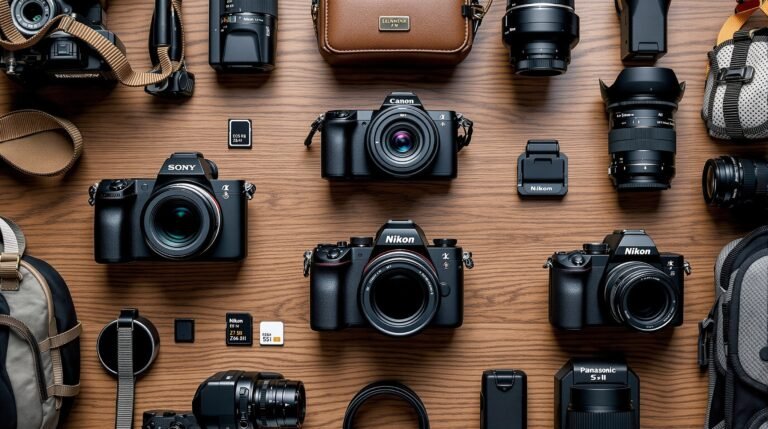
Epic Camera Battles
In the dynamic world of photography, choosing the right camera can make or break your creative output. With brands like Canon, Nikon, Sony, and others vying for dominance, navigating the options requires a deep dive into specs, performance, and real-world applications. This 2000-word comparison pits 10 top cameras against each other, spanning mirrorless, compact, and smartphone categories. Tailored for comparison researchers, this article breaks down key features—resolution, autofocus, video, build quality, and price—to help you make an informed decision. Whether you’re a professional photographer or an enthusiast, these battles reveal which camera reigns supreme.
Why Compare Cameras?
Selecting a camera involves weighing trade-offs between features, budget, and intended use. With rapid advancements in sensor technology, autofocus systems, and video capabilities, understanding differences is critical. This article evaluates cameras based on:
- Sensor and Resolution: Determines image detail and cropping flexibility.
- Autofocus: Measures tracking accuracy for fast-moving subjects.
- Video Capabilities: Assesses resolution, frame rates, and formats for filmmakers.
- Build and Ergonomics: Evaluates durability, weight, and usability.
- Price and Value: Balances cost against performance.
Each battle includes pros, cons, a verdict, and links to trusted sources like DPReview and RTINGS for further research. Let’s dive into the matchups!
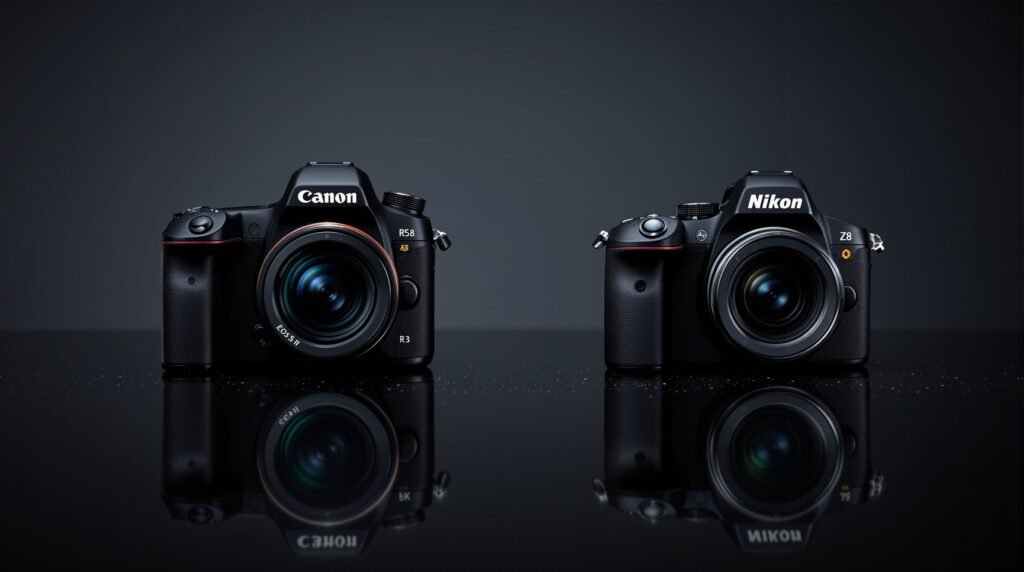
Battle 1: Canon EOS R5 II vs. Nikon Z8
Canon and Nikon’s flagship mirrorless cameras target professionals seeking high resolution and blazing speed.
Sensor and Resolution
The Canon EOS R5 II features a 45MP full-frame stacked CMOS sensor, delivering images at 8192 x 5464. The Nikon Z8 edges it out with a 46MP sensor, offering 8256 x 5504 for slightly sharper details, ideal for large prints or heavy cropping. Source: DPReview.
Autofocus
Canon’s 4897 autofocus points surpass Nikon’s 493, providing superior precision for dynamic scenes like sports or wildlife. Both support advanced tracking and face detection, but Canon excels in low-light conditions.
Video Capabilities
The Nikon Z8 leads with 8K at 30p and 4K at 120p in ProRes, catering to filmmakers needing high-resolution output. Canon EOS R5 II supports H.264/H.265 but lacks detailed high-frame-rate specs in comparisons, giving Nikon the edge for video.
Build Quality and Price
The Nikon Z8’s magnesium alloy body weighs 910g and retails at $3999. The Canon EOS R5 II, lighter at 746g, costs $4299, appealing to those prioritizing portability.
Pros and Cons
- Canon EOS R5 II: Pros: Longer battery life (540 shots), more autofocus points. Cons: Slower max shutter (1/8000s), higher price.
- Nikon Z8: Pros: Superior video options, higher resolution. Cons: Shorter battery life (340 shots), heavier.
Verdict
The Nikon Z8 triumphs for video creators and budget-conscious pros, while the Canon EOS R5 II suits stills photographers needing autofocus precision. Explore more at DPReview.
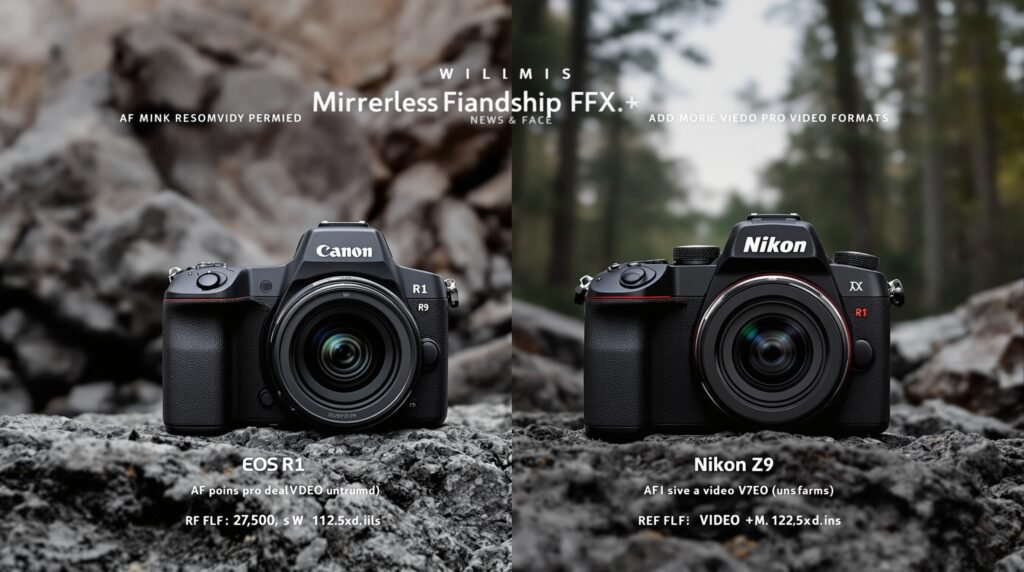
Battle 2: Canon EOS R1 vs. Nikon Z9
These flagship mirrorless cameras cater to sports and wildlife photographers demanding speed and durability.
Sensor and Resolution
The Canon EOS R1 offers a 24MP (effective 27MP) full-frame stacked CMOS sensor. The Nikon Z9’s 46MP (effective 52MP) sensor captures finer details, perfect for detailed landscapes or prints. Source: DPReview.
Autofocus
Canon’s 4897 AF points outshine Nikon’s 493, ensuring precise tracking in challenging conditions. Both excel at face detection and subject tracking.
Video Capabilities
The Nikon Z9 supports 8K with ProRes, outpacing Canon’s unspecified video specs, making it a filmmaker’s choice.
Build Quality and Price
Both feature magnesium alloy bodies. The Nikon Z9 weighs 1340g and costs $5500, while the Canon EOS R1 is lighter at 1115g but pricier at $6299.
Pros and Cons
- Canon EOS R1: Pros: Lighter, more AF points. Cons: Lower resolution, higher cost.
- Nikon Z9: Pros: Higher resolution, built-in GPS, better value. Cons: Heavier.
Verdict
The Nikon Z9 excels for resolution and price. Dive deeper at DPReview.
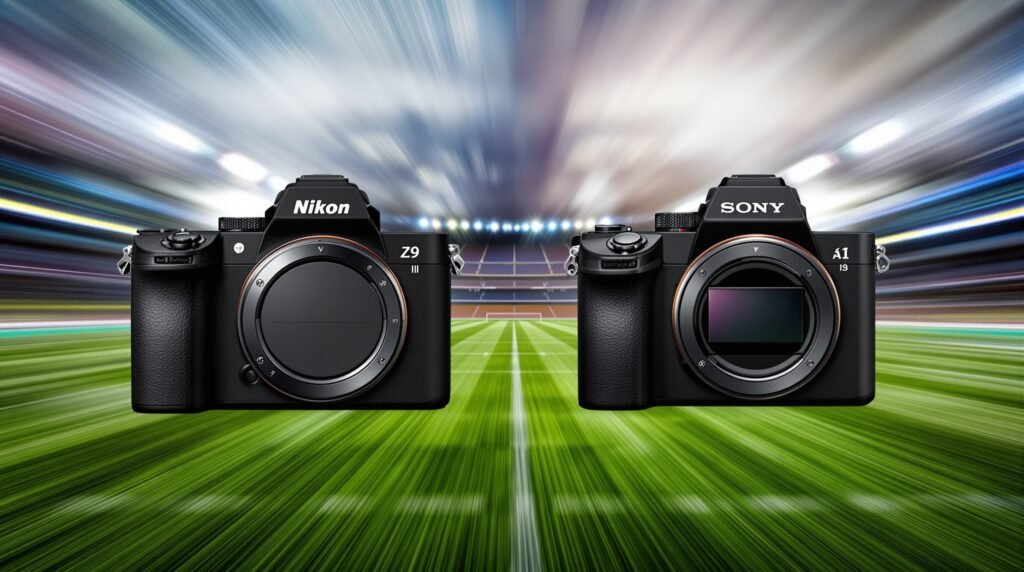
Battle 3: Nikon Z9 vs. Sony a9 III
Nikon and Sony compete for speed in professional sports photography.
Sensor and Resolution
The Nikon Z9’s 46MP stacked CMOS sensor outperforms the Sony a9 III’s 25MP, offering more detail for cropping. Source: DPReview.
Autofocus
Nikon’s 493 AF points match Sony’s robust system, though Sony’s real-time tracking shines for video.
Video Capabilities
Nikon’s 8K recording surpasses Sony’s 4K/120p, ideal for high-resolution video projects.
Build Quality and Price
The Sony a9 III is lighter (617g) than the Nikon Z9 (1340g). Nikon retails at $5500, with Sony at a similar price point.
Pros and Cons
- Nikon Z9: Pros: Higher resolution, GPS. Cons: Heavier.
- Sony a9 III: Pros: Compact, lighter. Cons: Lower resolution.
Verdict
The Nikon Z9 wins for detail-oriented pros. Check benchmarks at RTINGS.
Battle 4: Canon EOS R8 vs. Nikon Z5
Entry-level full-frame cameras for enthusiasts upgrading from APS-C.
Sensor and Resolution
Both feature 24MP full-frame CMOS sensors. The Nikon Z5’s max resolution (6016 x 4016) slightly edges the Canon EOS R8’s (6000 x 4000). Source: DPReview.
Autofocus
Canon’s 1053 AF points outperform Nikon’s 273, offering better tracking for moving subjects.
Video Capabilities
The Canon EOS R8 supports 4K/60p, surpassing the Nikon Z5’s 4K/30p, making it ideal for video enthusiasts.
Build Quality and Price
The Nikon Z5 (675g, magnesium alloy) costs $1399, while the Canon EOS R8 (461g) is $1499.
Pros and Cons
- Canon EOS R8: Pros: More AF points, better video. Cons: Mono audio.
- Nikon Z5: Pros: Stereo audio, dual card slots. Cons: Fewer AF points.
Verdict
The Canon EOS R8 shines for video; the Nikon Z5 excels for audio and storage. See reviews at Photography Blog.
Battle 5: Canon EOS R6 Mark II vs. Sony A7 IV
Hybrid cameras balancing stills and video for versatile creators.
Sensor and Resolution
The Canon EOS R6 Mark II’s 24MP sensor lags behind the Sony A7 IV’s 33MP, which offers more cropping flexibility. Source: Mirrorless Comparison.
Autofocus
Sony’s real-time tracking edges Canon’s robust system for video, though both excel in stills.
Video Capabilities
Both support 4K/60p 10-bit. Sony avoids overheating, while Canon may struggle in extended shoots.
Build Quality and Price
Canon costs $1999, Sony $2499. Both offer excellent ergonomics.
Pros and Cons
- Canon EOS R6 Mark II: Pros: Faster burst (40fps), better ergonomics. Cons: Lower resolution.
- Sony A7 IV: Pros: Higher resolution, no overheating. Cons: Slower RAW burst.
Verdict
The Sony A7 IV excels for landscapes; Canon for action. Explore at Mirrorless Comparison.
Battle 6: Nikon Z6 III vs. Sony A7 IV
Mid-range full-frame cameras for versatile shooting.
Sensor and Resolution
The Nikon Z6 III’s 25MP sensor trails the Sony A7 IV’s 33MP. Source: Photography Life.
Autofocus
Sony’s system is more reliable, though Nikon’s improved AF is competitive.
Video Capabilities
Nikon’s 6K/60p RAW outpaces Sony’s 4K/60p 10-bit.
Build Quality and Price
Both are priced at $2499 with solid builds.
Pros and Cons
- Nikon Z6 III: Pros: Superior video specs, better battery. Cons: Lower resolution.
- Sony A7 IV: Pros: Higher resolution. Cons: Slower burst.
Verdict
The Nikon Z6 III wins for video; Sony for stills. Visit Photography Life.
Battle 7: Fujifilm X-T5 vs. OM System OM-1
APS-C vs. Micro Four Thirds for travel and street photography.
Sensor and Resolution
The Fujifilm X-T5’s 40MP APS-C sensor doubles the OM-1’s 20MP MFT, delivering sharper images. Source: Camera Decision.
Autofocus
Fujifilm’s hybrid system offers more points, improving tracking accuracy.
Video Capabilities
Fujifilm’s 6.2K/30p edges OM-1’s 4K/60p for resolution.
Build Quality and Price
Both are weather-sealed. Fujifilm costs $1699, OM-1 $2199.
Pros and Cons
- Fujifilm X-T5: Pros: Higher resolution, lighter lenses. Cons: No GPS.
- OM System OM-1: Pros: Superior IBIS. Cons: Smaller sensor.
Verdict
The Fujifilm X-T5 excels for resolution. Check Camera Decision.
Battle 8: Leica Q3 vs. Fujifilm X100VI
Compact fixed-lens cameras for everyday carry.
Sensor and Resolution
The Leica Q3’s 60MP full-frame sensor outresolves the Fujifilm X100VI’s 40MP APS-C. Source: 5050 Travelog.
Autofocus
Leica excels in low-light autofocus, while Fujifilm is solid but less advanced.
Video Capabilities
Leica’s 8K surpasses Fujifilm’s 6.2K, offering cinematic quality.
Build Quality and Price
Leica’s premium build costs $6295; Fujifilm’s $1599 is budget-friendly.
Pros and Cons
- Leica Q3: Pros: Superior image quality, build. Cons: Expensive.
- Fujifilm X100VI: Pros: Affordable, film simulations. Cons: Lower resolution.
Verdict
The Fujifilm X100VI wins for value. See 5050 Travelog.
Battle 9: Sony A7S III vs. Panasonic Lumix S5 II
Video-focused full-frame cameras for filmmakers.
Sensor and Resolution
The Sony A7S III’s 12MP sensor prioritizes low-light performance; the Panasonic S5 II’s 24MP offers more detail. Source: Versus.
Autofocus
Sony’s tracking is superior; Panasonic’s phase-detect is reliable but less refined.
Video Capabilities
Both support 4K/120p. Panasonic’s fan cooling prevents overheating.
Build Quality and Price
Sony costs $3499; Panasonic $1999, with similar builds.
Pros and Cons
- Sony A7S III: Pros: Better low-light, tracking. Cons: Lower resolution.
- Panasonic S5 II: Pros: Fan cooling, value. Cons: Less dynamic range.
Verdict
The Panasonic S5 II shines for budget-conscious filmmakers. Visit Versus.
Battle 10: iPhone 16 Pro vs. Samsung Galaxy S25 Ultra
Smartphone giants for mobile photography.
Sensor and Resolution
The Samsung Galaxy S25 Ultra’s 200MP main sensor dwarfs the iPhone 16 Pro’s 48MP, offering unmatched detail.
Autofocus
Both feature advanced phase-detect; Samsung excels in zoom scenarios.
Video Capabilities
Samsung’s 8K recording surpasses iPhone’s 4K/120p for future-proofing. Source: GSMArena.
Build Quality and Price
Both are premium. Samsung costs $1299, iPhone $1099.
Pros and Cons
- Samsung Galaxy S25 Ultra: Pros: Versatile zoom, high resolution. Cons: Overprocessed images.
- iPhone 16 Pro: Pros: Natural colors, seamless ecosystem. Cons: Limited zoom.
Verdict
The Samsung Galaxy S25 Ultra excels for versatility. Check GSMArena.
Conclusion
These 10 camera battles showcase the diversity of photography tools in 2025. Nikon and Sony dominate hybrid performance, Canon leads in autofocus precision, and Fujifilm offers value in compacts. Smartphones like Samsung push mobile photography boundaries. Choose based on your priorities—resolution, video, portability, or budget. For deeper insights, explore trusted sources like DPReview, RTINGS, and Photography Life.
FAQs
- Which camera is best for professional photography?
The Nikon Z8 and Canon EOS R5 II excel due to high resolution and autofocus capabilities. - Are smartphones viable for professional photography?
Yes, the Samsung Galaxy S25 Ultra’s 200MP sensor rivals entry-level mirrorless cameras for versatility. - How important is autofocus in camera selection?
Critical for action shots; Canon’s systems (e.g., EOS R1) lead in point count and accuracy. - What’s the best budget camera?
The Fujifilm X100VI offers premium features at $1599, ideal for enthusiasts.