
Vivo X200 FE vs Vivo V60 A Detailed Comparison
Introduction
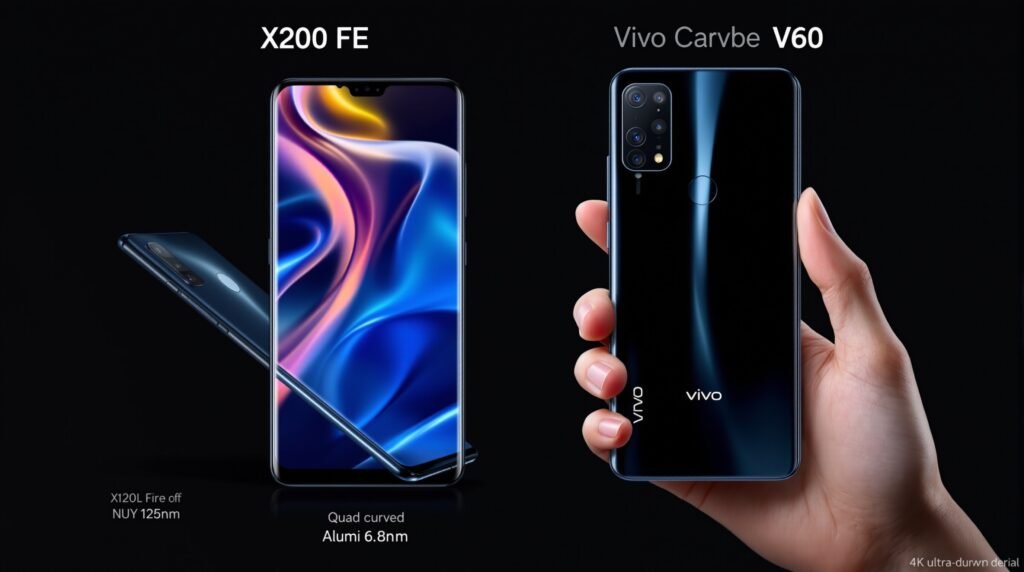
Smartphone enthusiasts constantly seek devices that balance performance, features, and value. Vivo, a leading player in the mobile industry, offers two compelling options in its 2025 lineup: the Vivo X200 FE and the Vivo V60. The X200 FE positions itself as a compact flagship killer with premium specs, while the V60 appeals to users who prefer a larger screen and mid-range efficiency.
This comparison dives deep into their similarities and differences, helping global users make an informed choice. Whether you prioritize portability or immersive viewing, we break it down step by step.
Both phones launched in 2025—the X200 FE in July and the V60 in August—and share some core traits like a 6500mAh battery and triple-camera setups. However, key distinctions in chipset, display resolution, and build make them cater to different preferences. We draw from reliable sources like GSMArena and Vivo’s official specifications to ensure accuracy.
Design and Build Quality
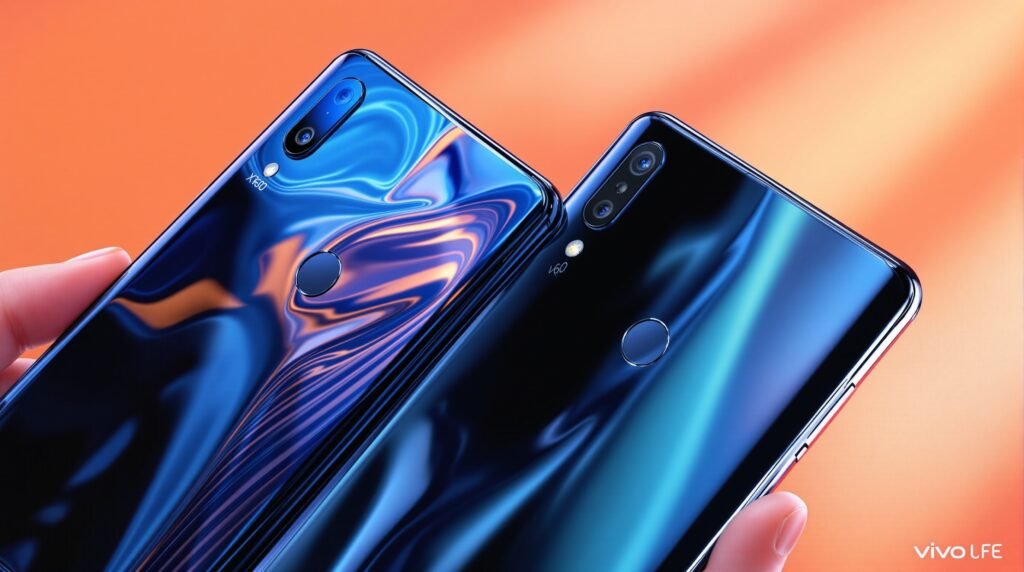
Vivo crafts both devices with premium materials, but their designs target distinct user experiences. The Vivo X200 FE measures 150.83mm x 71.76mm x 7.99mm and weighs just 186g, making it incredibly compact and easy to handle with one hand.
Its glass front and back, paired with an aluminum frame, deliver a sleek, modern aesthetic. The phone boasts IP68/IP69 dust and water resistance, ensuring it withstands splashes and submersion. Available in colors like Midnight Black and Aurora Green, the X200 FE features a glass film back cover for added durability and a premium feel.
In contrast, the Vivo V60 adopts a larger footprint at approximately 17.20cm (height) with a weight of 192g or 201g, depending on the variant. It also uses glass for the front and back but incorporates a quad-curved design for a more immersive edge-to-edge look. Like its counterpart, it offers IP68/IP69 ratings, protecting against dust and water. The V60’s build emphasizes comfort for extended use, with options in vibrant shades such as Sunset Orange and Titanium Gray.
The X200 FE wins for portability, ideal for users on the go, while the V60’s larger size suits those who multitask or consume media frequently. Both include in-display optical fingerprint sensors for quick, secure unlocking.
Display
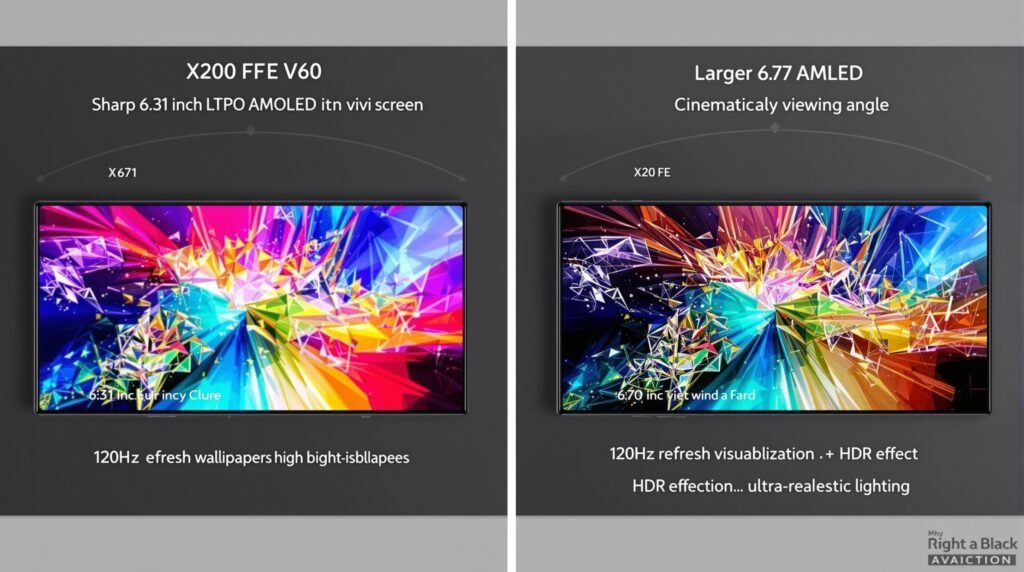
Displays play a crucial role in user satisfaction, and here the differences shine. The Vivo X200 FE sports a 6.31-inch LTPO AMOLED panel with a 1.5K resolution of 1216 x 2640 pixels. This setup delivers sharp visuals, vibrant colors (up to 1 billion), and a 120Hz refresh rate for smooth scrolling. With HDR10+ support and peak brightness reaching 4500-5000 nits, it excels in outdoor visibility and media playback. The 2160Hz PWM dimming reduces eye strain during low-light use.
On the other hand, the Vivo V60 features a larger 6.77-inch AMOLED display with a Full HD+ resolution of 1080 x 2392 pixels. It also supports a 120Hz refresh rate (with a 60Hz option for battery saving) and offers capacitive multi-touch for responsive interactions. While the brightness is solid at around 1800 nits, it falls short of the X200 FE’s peak levels. The quad-curved edges enhance immersion, making it great for videos and gaming.
If you crave pixel-dense sharpness in a compact form, choose the X200 FE. For a bigger canvas perfect for streaming Netflix or browsing, the V60 takes the lead.

Performance and Software
Performance defines how smoothly a phone handles tasks, and the Vivo X200 FE outpaces the V60 here. It packs the MediaTek Dimensity 9300+ chipset (4nm process), an octa-core CPU clocked up to 3.4GHz, and the Immortalis-G720 MC12 GPU.
Paired with 12GB or 16GB RAM and 256GB/512GB storage (UFS 4.0), it tackles demanding games like Genshin Impact and multitasking effortlessly. Benchmarks show it rivaling flagship chips, with excellent thermal management.
The Vivo V60 relies on the Qualcomm Snapdragon 7 Gen 4 processor, a mid-range octa-core setup reaching 2.8GHz. It comes with 8GB, 12GB, or 16GB RAM (plus virtual RAM extension) and up to 512GB storage. While capable for everyday apps, social media, and light gaming, it lags in intensive scenarios compared to the X200 FE’s superior GPU and efficiency.
Both run Android 15 with Vivo’s Funtouch OS 15 overlay, providing a clean interface, gesture navigation, and features like AI enhancements. Vivo promises three years of OS updates and four years of security patches for both, ensuring longevity.
Gamers and power users will appreciate the X200 FE’s edge, while casual users find the V60 sufficient and more affordable.
Camera System
Vivo excels in photography, and both models feature Zeiss-tuned cameras. The Vivo X200 FE’s triple rear setup includes a 50MP main sensor (Sony IMX921 with OIS), a 50MP ultrawide (Samsung JN3), and an 8MP telephoto with 3x optical zoom.
It captures stunning details in daylight, low-light portraits with natural bokeh, and 4K videos at 60fps. The 50MP front camera handles selfies and vlogs with AI beauty modes.
The Vivo V60 mirrors this with a 50MP main (Zeiss optics), 8MP ultrawide, and 50MP telephoto. It performs admirably in various lighting, thanks to OIS and AI processing, but the X200 FE’s sensors edge it out in dynamic range and zoom quality. Both support 2160p video recording and a 50MP selfie camera.
Camera tests reveal the X200 FE shines in professional shots, while the V60 excels in quick, everyday photography.
Battery Life and Charging
Battery endurance ties these phones together. Both house a massive 6500mAh battery, delivering all-day usage even with heavy streaming or gaming. Vivo’s BlueVolt technology maintains capacity after years of use.
Charging speeds impress with 90W wired FlashCharge, juicing up from 0-50% in about 20 minutes. The X200 FE adds 50W wireless charging, a premium perk absent in the V60. No reverse charging on either, but efficient power management keeps them running longer.
Additional Features
Both include stereo speakers, NFC for payments, and 5G connectivity. The X200 FE offers better vibration haptics and a more advanced cooling system for sustained performance. Security features like face unlock complement the fingerprint sensor.
Specs Comparison Table
| Feature | Vivo X200 FE | Vivo V60 |
|---|---|---|
| Display | 6.31-inch LTPO AMOLED, 1216×2640, 120Hz | 6.77-inch AMOLED, 1080×2392, 120Hz |
| Chipset | MediaTek Dimensity 9300+ | Qualcomm Snapdragon 7 Gen 4 |
| RAM/Storage | 12/16GB RAM, 256/512GB | 8/12/16GB RAM, 128/256/512GB |
| Rear Camera | 50MP + 50MP + 8MP | 50MP + 8MP + 50MP |
| Front Camera | 50MP | 50MP |
| Battery | 6500mAh, 90W wired, 50W wireless | 6500mAh, 90W wired |
| Dimensions/Weight | 150.8×71.8×7.99mm, 186g | ~172x75x8mm, 192-201g |
| OS | Android 15, Funtouch OS 15 | Android 15, Funtouch OS 15 |
| Price | Varies by region (check official site) | Varies by region (check official site) |
Price and Availability
Prices fluctuate by market, but the X200 FE typically commands a premium due to its flagship chipset. Visit Vivo’s official website for current pricing in your region: Vivo X200 FE and Vivo V60. For detailed reviews, check GSMArena: X200 FE Review and V60 Specs.
Conclusion
The Vivo X200 FE emerges as the superior choice for users seeking compact power, exceptional performance, and advanced features like wireless charging. It suits professionals, gamers, and photography enthusiasts who value premium build and display quality.
Conversely, the Vivo V60 shines for budget-conscious buyers wanting a large screen, reliable battery, and solid cameras without breaking the bank. It fits casual users focused on media consumption and everyday tasks.
Ultimately, your decision hinges on priorities: opt for the X200 FE if performance tops your list, or the V60 for value and size. Both adhere to high standards, ensuring neither disappoints in 2025’s competitive market.